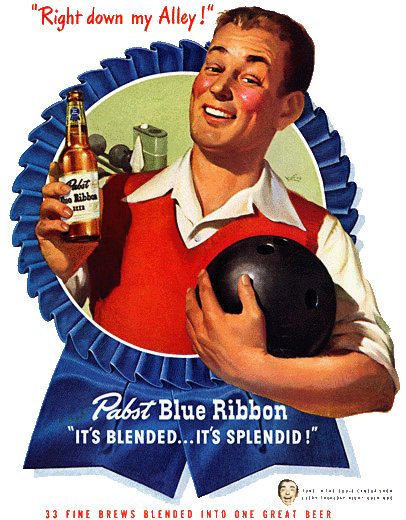
Pabst Blue Ribbon


Review Date 8/1/2001 Last Updated 2/1/2026 By John Staradumsky
Imagine, if you will, stopping
by your neighborhood Wendy’s for a hamburger. You place your order and wait
patiently for it to be filled. To your surprise, you see a Wendy’s employee
in the back room with an armful of Burger King bags. He unpacks them
carefully, and you notice that they’re full of burgers that employees soon
unwrap and then re-wrap in Wendy’s paper coverings. You’re astonished and
curious, but also very hungry, so you eat your lunch, all the while
wondering what is going on. Finally, you decide to ask the manager for an
explanation. “It’s simple,” he replies. “We’ve decided it’s cheaper for us
to buy our burgers elsewhere than to make our own.”
Sound like madness? It’s happening in the beer world. A few weeks ago, Pabst
Brewing Company, the nation’s fourth largest brewer behind Anheuser-Busch,
Miller, and Coors announced it was closing its last brewery and would be
transferring all of its production to Miller Brewing on a contract basis.
Pabst explains that the move will reduce operating costs for the company, a
notion that is puzzling to some. Can we expect in the near future to see
Coke bottling cola for Pepsi, Kellogg packaging cereal for General Mills, or
perhaps Chrysler having all its cars made for it by Ford? It’s hard to
imagine a manufacturer of any product shifting his production to a
competitor, but in the strange business of beer, so it goes.
Contract Brewing, or the practice of renting another brewery’s excess
capacity is of course nothing new. However, this usually happens when a
company desires to operate a brewery but either has insufficient capital to
do so or wishes to establish a market for its product before committing to
the major investment that operating a brewery entails. Witness the Boston
Beer Company, which for years operated only a small test brewery in Boston
and a brewpub in Philadelphia, contracting out production of its beer to
regional brewers across America. Eventually, however, the company purchased
the Hudepohl-Schoenling brewery in Cincinnati where it had previously
contract-brewed beer. Curiously, Pabst has gone the opposite route from
brewer to contract brewer.
Making great beer is tradition here at Pabst Brewing, and we hope you
enjoy your visit, as well as the fine beer from the Pabst family of brands.
The above is taken from the Pabst website. Sadly, the tradition of making
beer at all seems to have ended for Pabst. The company has a long and
prestigious history of brewing that includes being the number one brewer in
the country at the dawn of the twentieth century. Oh, how the mighty have
fallen. The company’s roots date back to 1844 when German Immigrant Jacob
Best established a brewery in Milwaukee, Wisconsin. The company takes its
name, however, from Captain Frederick Pabst, who married Jacob’s daughter in
1862 and became an equal partner in 1864 of the company that would bear his
name from 1889 on. Best retired in 1866, and from that point forward Pabst
directed the company towards ever increasing sales.
Such are the beginnings of Pabst Brewing Company. The brewing world today is
a far cry from what it was in the days of the mid to late nineteenth
century, however, and Pabst has of late been a major player in the mess that
American business has made of a once proud vocation. Back in 1996, the major
news in the brewing world was the acquisition of the G. Heileman Brewing
Company, then one of America’s largest brewers behind Anheuser Busch,
Miller, Coors, Pabst, and Stroh, by the Stroh Brewing Company of Detroit,
Michigan. No sooner had Stroh digested Heileman and it’s popular local
brands Old Style (which was a huge brand in Chicago and parts of the
Midwest), Mickey’s, Black Label, Blatz, Henry Weinhard’s and many others
than it was in turn gobbled up by Pabst in 1999. Sadly, all of these
once-proud brands have been reduced to just another label by the corporate
mentality of today’s large brewers.
Pabst Blue Ribbon beer got the name from the numerous awards it had received
back in the nineteenth century. The beer pours to a light yellow color with
a very fizzy head that fades away almost as quickly as it forms. The nose is
very light and watery. The palate is very light as well, with just a touch
of malt and some corn adjunct character. There’s just not much going on here
to set the beer apart from water right on into the slightly sweet finish. I
can’t recommend this beer on any basis, and with the closing of the last
Pabst brewery I’m not sure if its low price (the beer’s main selling point)
will be enough to save it in the future. I can’t see how Pabst will be able
to brew a beer at Miller, pay Miller enough for them to make a profit on it,
mark it up themselves and still sell it for less than beer Miller can make.
Update: October 27th, 2013: Lately, I've sort of had a rethinking on Pabst Blue Ribbon, and come to the conclusion I may have been too hard on this beer. When considered as what it's supposed to be, an American Lager, it isn't all that bad, and hey, it is what it's supposed to be. Pabst does have a habit of turning up at good beer places. Tasted today on tap at Taco Mac, it was clean and crisp with just a hint of adjunct distraction, and was a reasonable starter beer for a warm afternoon of watching football. And it just $3 for a draft, you can't argue with the price.
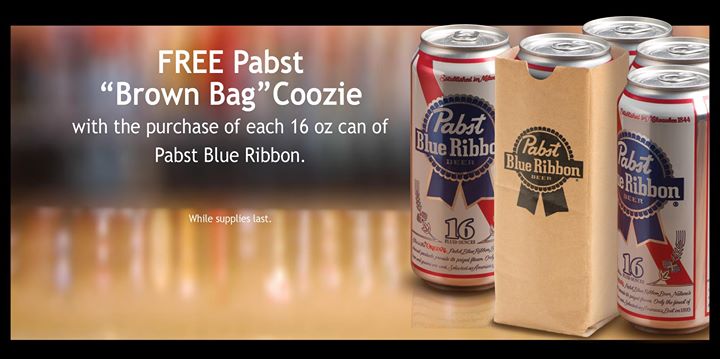
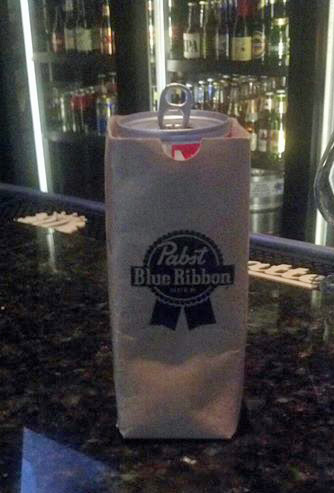
Not that long ago (May of 2013 actually), Taco Mac had another $3 Pabst special, then for a 16-punce kinger can with a free paper-bag style can coozie. The coozie was really cool, and plastic coated, so I had to have one. Still and all, I prefer Pabst on draft to the canned version.
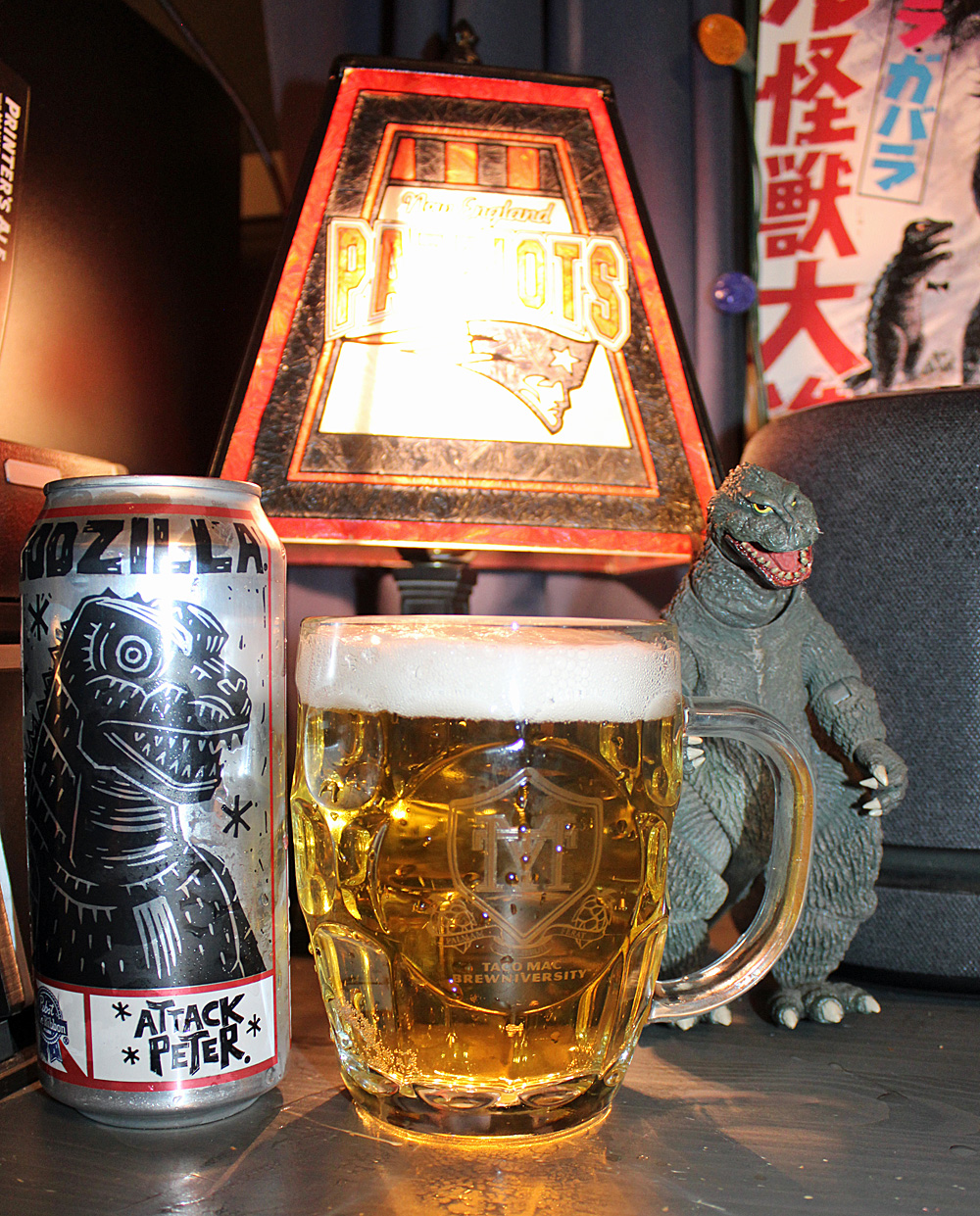
Update February 1st, 2026: I will admit it: Pabst Blue Ribbon remains a guilty pleasure. It's an American Light Lager that reminds me of my earliest days in beer drinking, and it remains one of the least expensive beers you can buy. I enjoyed a 23-ounce draft mug for just $1.79 at Taco Mac on June 3rd of 2021. That's an incredible price, only slightly more per ounce than what I paid for a six-pack of pint cans recently at Ingles market. I bought that six-pack, of course, because Pabst Blue Ribbon cans currently feature none other than the King of the Monsters himself, Godzilla. Pint cans (in 6 packs, 30 packs, and 99-packs) feature Godzilla; 25-Ounce singles also have Mothra, King Ghidora, or Mechagodzilla on the label. The beer remains softly malty and creamy with a hint of corn adjunct. Judge it to style and it is not a bad example of American lager.
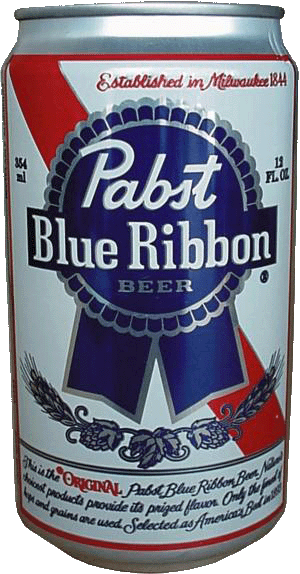
From the label of my cans:
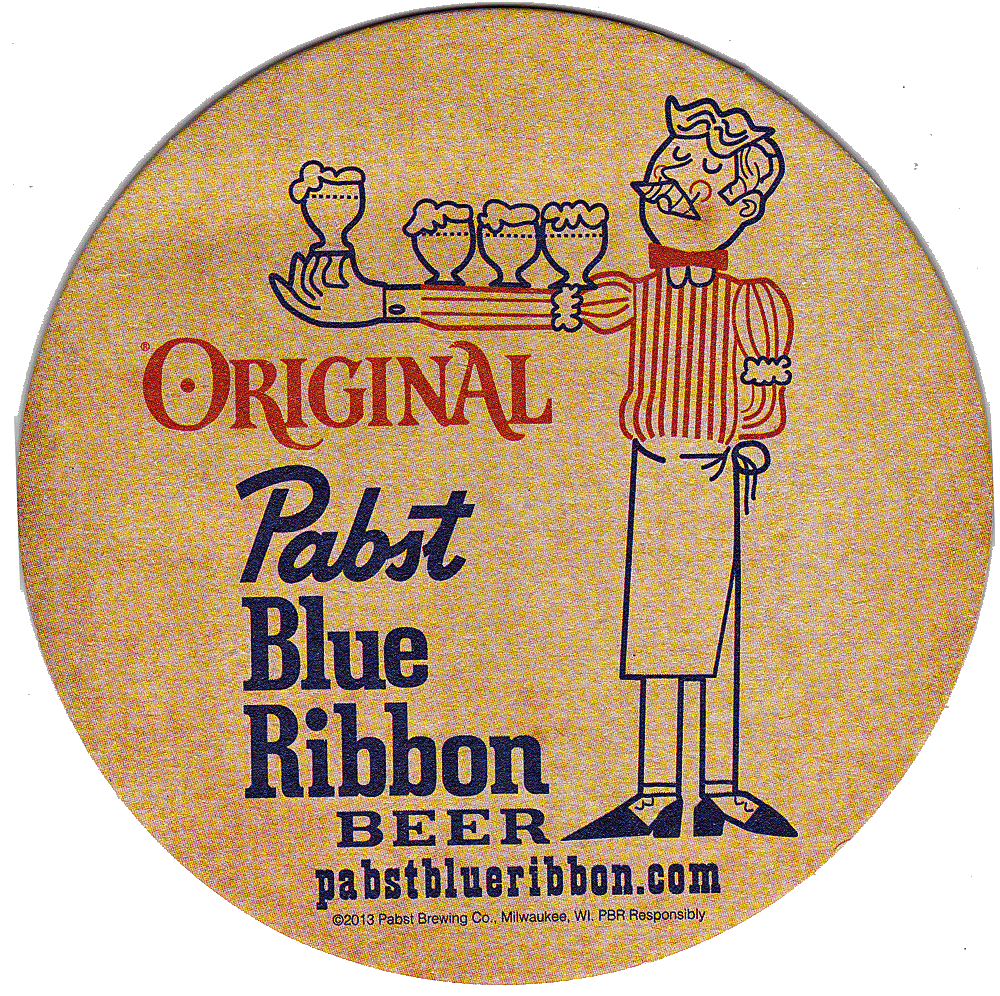
This is the original Pabst Blue Ribbon beer. Nature's choicest products provide its prized flavors. Only the finest of hops and grains are used. Selected as America's Best in 1893.


Glad I tried it?
 T
T
Would I rebuy it??
*Pricing data accurate at time of review or latest update. For reference only, based on actual price paid by reviewer.
(B)=Bottled, Canned
(D)=Draft
